.png)
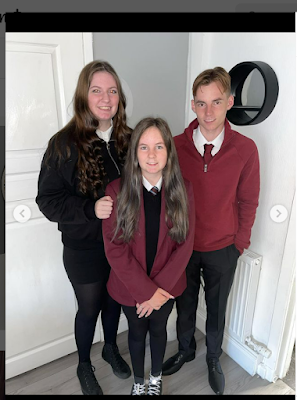
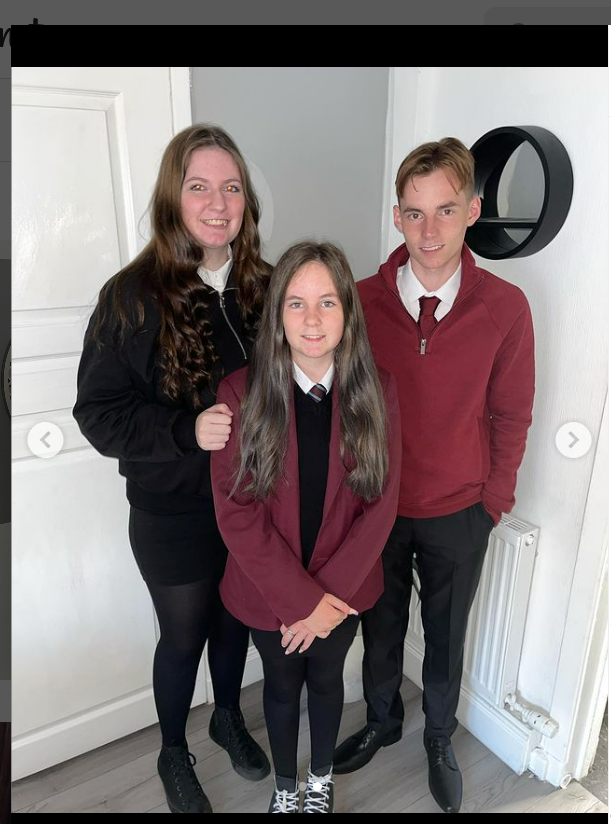
A wee bit late with this but the little people have returned to school for another term. Except some of them aren't little any more. Ava has now joined her big brother and sister at high school. Is it any wonder I've so little hair...?
A wee bit late with this but the little people have returned to school for another term. Except some of them aren't little any more. Ava has now joined her big brother and sister at high school. Is it any wonder I've so little hair...?


It’s 1914. One of the bloodiest conflicts the world has seen – described at the time as the ‘war to end all wars’ – breaks out in Europe. In Scotland, football continues and is seen by many as a welcome distraction from the horrors of war in Europe. However, there are many who feel those playing football should be turning their attention to more serious matters on foreign shores.
At the top of the Scottish First Division sit Heart
of Midlothian FC. They have won 19 of 21 matches and it seems no one can stop
Edinburgh’s finest football club becoming Scottish league champions. Then, James
Speedie, one of Hearts top players says he is going to volunteer to serve his
country – conscription wasn’t introduced until 1916. Thirteen of the Hearts
players would volunteer to serve together in Sir George McCrae’s Battalion
destined to fight in France. They were joined by Hearts supporters and players
and supporters of other clubs after a rallying call at Edinburgh’s Usher Hall.
A War of Two Halves is the story of these young
Hearts players; an evocative and dramatic journey through Tynecastle Park led
by the players/soldiers in a unique site-specific performance.
I first saw this production in 2018 and was hugely
impressed by the acting, direction and production. The passion of the actors
shines through and, four years later, the standards are as high as they were
then.
The passion shown by those young actors is what is
striking about this performance. When you sit in the present-day Hearts
changing room at Tynecastle – as part of the performance – the presence of
these young actors, resplendent in the Hearts strip of 1914 takes you back more
than a century. Hearts manager John McCartney, excellently played by Tim
Barrow, grows through emotional turmoil as his young charges leave the front of
the First Division to a very different and frightening front on foreign land.
The story begins with Alfie Briggs – one of the
Hearts players in that famous team – played with some style by Bryan Lowe and
you know Lowe is an ardent Hearts supporter by the way he kisses the maroon
shirt in the opening minutes. Acting doesn’t teach you this – it comes from the
heart.
Others such as Paul Beeson as Alfie, Euan Bennet as
Annan Ness and Fraser Bryson as Patrick Crossan – the self-proclaimed most
handsome of the Hearts team! - equally impress and it is little wonder this
show was a sell-out in 2018 and 2019 before the ravages of Covid-19 brought the
show to a halt.
This is a passionate and very well acted story which
leaves a lump in the throat not only for those Hearts supporters present but for
everyone else witnessing this superb production.
Written by Paul Beeson & Tim Barrow, and
featuring a cast of young Scottish actors, A War of Two Halves is directed by
Bruce Strachan, Artistic Director of Nonsense Room Productions.
Fans of all football clubs are welcome. Indeed, even
if you’re not a football fan you can’t fail to feel emotional at the telling of
this heart-warming yet tragic story. I defy you not to have a lump in your
throat at the end of the performance.
A five star rating all the way!
A War of Two Halves plays at Tynecastle Park August
7-23, 26-27. Tickets here
 |
| Photo: Mike Smith |
A couple of years ago, in happier days for stage and theatre before Covid-19 struck and the world was plunged into dark times, there was an excellent stage production - A War of Two Halves - staged at Tynecastle Park, the home of Edinburgh’s oldest and biggest football club Heart of Midlothian.
With lockdown restrictions eased somewhat – for now – the team
behind that excellent production is back with another breath-taking piece of
theatre. And again, the setting is Tynecastle Park.
With a highly talented nine-strong
ensemble, Sweet F.A. written by Paul Beeson and Tim Barrow, and produced
by Bruce Strachan is, like A War of Two Halves, set during the First World War
and tells the story of football players whose lives are deeply affected by the
events in the battlefield. This time, however, the story is of a group of women
factory workers at the North British Rubber Company in Edinburgh’s
Fountainbridge whose passion for football is almost as strong as their love for
their men in the fields of France. The women are involved in the production of
wellington boots for their loved ones fighting for their King and country.
Their story of everyday struggle alleviated by their love of
football and determination to form a football club at a time when women’s
football was most definitely frowned upon by the football authorities is an
extremely powerful one.
As you might expect it’s an all-female cast with some
stunning individual performances. From the opening scene when Daisy and Alice
meet each other for the first time in the Diggers pub – and there’s a nice wee
reference for those not familiar with Gorgie’s watering holes as to why the
Athletic Arms is called the Diggers – to a highly-charged ending when the
football suits in Glasgow finally get their way, Sweet F.A. transports you back
to a different era when equality was just a word in the dictionary and women’s
rights were restricted to a life looking after their menfolk, raising children
and spending most of their time in the family home.
It is a tragic tale in more ways in one. Most of the factory
girls are affected by personal loss in the war but this heart-tugging story of
courage is also one of forbidden love. Amidst
the emotionally charged scenes, however, there is biting humour and numerous
digs at the football authorities in Scotland, including today’s men in suits. It
says much for the brilliant writing and production of the show that they can
reference into a scene from more than a century ago last season’s controversial
SPFL vote which demoted Hearts from the top flight thanks to a missing vote
from Dundee F.C.
The action is impressive, too, particularly when the girls
play their Edinburgh arch-rivals from Ramage & Ferguson shipbuilders – who,
of course, hail from Leith. The women’s teams equivalent of Hearts-Hibs games. The
players describe the action in fine detail culminating with a pause for great
effect before wildly celebrating a ‘goal’.
The hugely impressive cast successfully convey the story of
how popular women’s football was during the First World War. And your
admiration for their achievements is accompanied with deep sympathy for the
huge emotional turmoil most of them go through. For Daisy and Alice this
emotional turmoil has added piquancy.
It’s remarkable to think the ban on women’s football that
followed in the early 1920s lasted nearly 50 years – in fact it was longer in
Scotland as the narrator explains with understandable bitterness. The frequent
digs at Scotland’s football authorities throughout the show went down well with
audience, not all of whom were of the maroon persuasion.
Even if you’re not into football you will be inspired by
this brilliant production. I didn’t want it to end and there must have been
something in my eye towards the end of the performance – honestly!
A five-star review for a five-star performance!
Sweet F.A. is on until Monday 30th August 2021.
Tickets here.


How about this....?
Winning, working women won’t you hear what we’ve tae say
We work our hands unto the bones for a quarter less in pay
We started our own football teams and showed them how to play
But when we ask for equal rights we’re given Sweet F.A.
1916. The men fight on the Western Front. The women work in the factories, and form football teams, playing other factory teams across Scotland and raising money for the war effort. Women’s football fast becomes the most popular game in the land. Worried that their game is starting to rival the men’s, the football authorities ban the women’s game in 1921.
Sweet F.A. tells the story of one women’s factory football team from Fountainbridge, fighting for their right to play the beautiful game.
Bruce Strachan, Director
Heart of Midlothian Football Club welcomes
audiences to their stadium, the historic Tynecastle Park:
Gary Locke, Club Ambassador,
Heart of Midlothian Football Club
Lianne
Parry, Head of Heritage, Heart of Midlothian Football Club
Tickets will be available from:
Edinburgh Fringe – www.edfringe.com
Universe Events – www.universe.com/users/heart-of-midlothian-football-club-4GP5VW

The effect of lockdown on one's mental health is intensified at times you would usually share with family and loved ones. I commiserated celebrated the beginning of the final year of my fifties on Friday but the usual family gathering was prevented due to lockdown rules in Scotland as a result of the Covid pandemic.
These technological times, however, meant I did get WhatsApp messages from my three of my five grandchildren (the youngest two still being a wee bit young for that sort of thing) and these highlighted it isn't just me who is getting older.
Jack, who will be 16 in a couple of months and, therefore, a young man sent me a typically polite 'Hope you have a good day' message.
Hannah, who will be 14 going on 24 in August, said 'Happy birthday Papapapapapapa' which is probably her way of showing a sense of humour. She does have a tendency to burst into a fit of the giggles for no apparent reason although this may be because I make her laugh without realising it aka extracting the Michael...
It was left to 10-year-old Ava to display the unconditional love which used to be a trademark of her older sister and brother by saying 'Happy birthday to the best Papa on Earth - miss you loads'. This brought a wee tear to my glass eye and underlined how much I miss them all, not having seen them since early November. I like to think Jack and Hannah share their wee sister's sentiments but they are now at the age when showing affection to one's elderly relatives may be deemed distinctly 'uncool'...
It was left to their mother to send me the above collage of my children and grandchildren which cleverly includes a headshot of my father who passed away in 1997. He would have been immensely proud of them all and I like to think he is looking down on all of us. It's a tragedy he never lived to see any of his great-grandchildren but he loved his granddaughters and I know Laura and Michaela still think of him. As I do every day.
Jack, Ava and Laura all have their own birthdays in May (that month costs me a bloody fortune) and I will see them then to join the celebrations - no matter what Scotland's First Minister says at that time. Covid cases in Scotland are falling as are hospital and ICU admissions whilst vaccines are rising in their thousands every day.
We need hope that we will be able to see our loved ones again very soon. Even rapidly ageing old gits like me...
A wee bit late with this but the little people have returned to school for another term. Except some of them aren't little any more. A...